
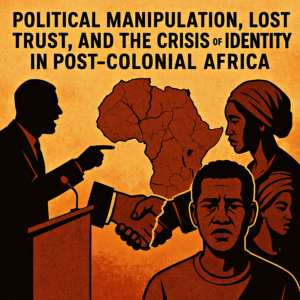
In Sierra Leone, aspirations for better living conditions drive education, migration, and opportunity-seeking, especially among youth. These ambitions influence national priorities, but sustainable progress depends on modernisation rooted in local culture rather than on the replication of foreign models. An overemphasis on global integration can lead to exclusion and erode cultural identity. Low public trust and elite dominance further alienate citizens. Genuine progress requires locally grounded transformation. This paper examines the historical and institutional roots of Sierra Leone’s development challenges, how modernisation affects identity, the economy, and education, and whether decentralisation can enable more inclusive growth. The main argument is that authentic decentralisation empowers communities to develop in culturally relevant ways within a unified nation.
The Legacy of Political Gaslighting and Institutional Betrayal
What the state promised and what people experienced
The Local Government Act 2004 shifted powers, responsibilities, and resources from central government to local councils, giving them authority over public services and local revenue. International donors, including the World Bank, supported these reforms. Notably, the World Bank’s 2011 DSDP-2 program allocated $26 million to improve key services, including health, water, sanitation, waste management, and infrastructure, across all nineteen local councils.
Many citizens found government and donor projects failed to deliver on promises, with hospitals remaining under-resourced—most evident during the 2014 Ebola crisis. Ongoing infrastructure problems, such as flooding and landslides, highlighted poor planning and maintenance, while remote areas saw little progress. As a result, decentralisation was viewed as superficial, increasing scepticism and feelings of exclusion, and undermining trust in leadership. However, some analysts argue these issues are common during transitions, noting that meaningful reforms take time and can eventually improve governance and services with continued investment.
Gaslighting through omission and distortion
The gap between official promises and real results constitutes political gaslighting, encouraging citizens to believe in progress despite ongoing infrastructure deficits and the marginalisation of local languages and histories. Claims that reforms are intended to enhance global competitiveness often shift blame for poverty to individuals rather than acknowledging institutional failures, thereby obscuring problems and preventing accountability.
This distortion extends beyond misinformation by concealing shortcomings and exaggerating achievements. Political messaging shapes collective memory and makes it harder to hold leaders responsible. As a result, many Sierra Leoneans now see traditional practices as obsolete and feel compelled to adopt outside models, even when those may be harmful.
Trust: The Currency That Collapsed
Trust in institutions, leadership, and communities is crucial for cohesion, but it is lacking in Sierra Leone. Of about 80 functions intended to be devolved to local councils, only 56 have been implemented. Councils face chronic underfunding, with local government spending making up just 1.9% of national expenditure in 2015/16. Tax collection is also weak due to public mistrust, poor understanding of taxation, and concerns about corruption, all of which reduce compliance.
Many citizens in Sierra Leone and Liberia rely on kinship and informal networks for security and resources due to weak formal institutions and legacies of centralised governance. Limited trust in government and unmet expectations have reinforced these informal structures, which are seen as more dependable than official avenues. While modernisation has introduced new connections, it often yields superficial change rather than genuine transformation, as reliance on traditional networks persists.
Modernisation Without Foundations: The Erosion of Local Economies and Cultures
Many young Sierra Leoneans view modernisation as urbanisation, learning English, pursuing a Western education, and consuming imported goods. However, these trends may not be sustainable without integrating local economies and traditions. Traditional industries such as pottery, agriculture, and fishing have declined due to increased formal education and the import of goods, including Asian rice and European second-hand clothing, thereby undermining rural livelihoods (World Bank, 2011). Education primarily focuses on Western subjects, with limited attention to local languages and histories; secondary schools prioritise foreign literature over local narratives (Conteh, 2025). This shift risks cultural loss, dependency, and alienation among youth.
The Politics of Identity and Exclusion – How Modernisation Becomes a Gatekeeper
In Sierra Leone, political identity has long influenced access to power and resources, evolving from colonial divisions into entrenched ethno-regional party politics and patronage. Despite decentralisation reforms after the civil war, local authorities remain divided between elected councils and traditional leaders, resulting in unclear governance and ongoing disputes. This system tends to favour those with strong regional, ethnic, or political ties, while others are often excluded from development opportunities.
Education: Between Alienation, Amnesia, and Missed Opportunity
Sierra Leone’s schools often favour Western languages and standards, sidelining local knowledge and traditions. Decentralisation has shifted resources to technical education while reducing emphasis on history and arts. This leaves students academically successful but detached from community heritage, contributing to brain drain and skills mismatches (World Bank, 2011). Neglecting indigenous culture weakens the role of education in local and national development.
Collective Trauma, Learned Hopelessness When Modernisation Masks Pain
Sierra Leone’s history—from slavery and colonialism to civil war, Ebola, disasters, and inequality—continues to impact its people profoundly. Persistent shortcomings in governance and development foster widespread hopelessness and disengagement from national politics. Many turn to informal work or migration, weakening community ties and eroding cultural identity. Without societal reconciliation and collective remembrance, lasting reforms remain at risk, and future generations may lose their sense of belonging.
Decentralisation: A Structure for Restoration What It Could Be, and What It Needs
Despite earlier setbacks, decentralisation retains significant potential as a governance framework, provided it is re-envisioned, reformed, and revitalised.
7.1 What Decentralisation Is and What It Was Supposed to Be.
Even with past challenges, decentralisation can still work well if it is updated, improved, and given new energy and authority over centralised public services, planning, development, taxation, and regional governance.
Recent empirical research (2025) shows that while residents of Kenema District Council reported improvements in infrastructure and government buildings, issues like low revenue mobilisation, limited public engagement, perceptions of corruption, and poor tax knowledge persist. Although interventions such as fiscal education and accountability measures may help, ongoing challenges suggest that piecemeal solutions are insufficient. The following discussion outlines targeted recommendations for more effective and sustainable decentralisation reforms.
Critical Preconditions: What Must Change for Decentralisation to Work
Decentralisation can be effective, but only if it is implemented with clear goals, sufficient resources, and strong accountability. Several important reforms are needed:
If these preconditions are met, decentralisation has the potential to translate aspirations for improved living standards into tangible, enduring advances tailored to local needs, rather than replicating external models.
Conclusion: Toward a New Social Contract Modernisation Rooted in Selfhood and Society
Modernisation in Sierra Leone is unlikely to succeed if it continues to replicate foreign models that marginalise history, suppress identity, and impose external paradigms. As demonstrated in this analysis, superficial reforms and externally driven solutions have resulted in exclusion, cultural loss, and diminished communal trust. Genuine progress must be grounded in local culture, foster trust, respect diversity, and empower communities to direct their own development.
To achieve this, policymakers and stakeholders should focus on specific, actionable steps:
Modernisation should reinforce, rather than diminish, Sierra Leonean identity. It should facilitate the adoption of new technologies and practices while maintaining a strong connection to traditional knowledge. Development initiatives ought to encompass all languages, ensure political representation for every community, and promote an inclusive sense of identity that unites rather than divides.
References